Most solitaire is somewhere to put your hands. This is somewhere to put your attention.
Solitaire is the game people open when they want to think about nothing in particular. Almost every version treats that as a reason to spend nothing on it — a flat green table, a stock card back, an ad between deals.
Tingle Solitaire spends everything there instead. The table is a scene you choose and it keeps moving while you play. Winning is worth watching. Nothing interrupts, nothing upsells mid-game, and there is no gate between opening it and dealing.
Six animated tables to start with.
Five are drawn and animated. The sixth is 4K video of actual water, running full frame behind the cards and dissolving between clips so it never cuts.
Twelve victory animations, one at random every win.
Cards cascade off the foundations. Fireworks launch from the board and burst overhead. Gravity runs backwards and the whole deck falls upward. Winning is the payoff, so it gets treated like one — and you never see the same one coming.
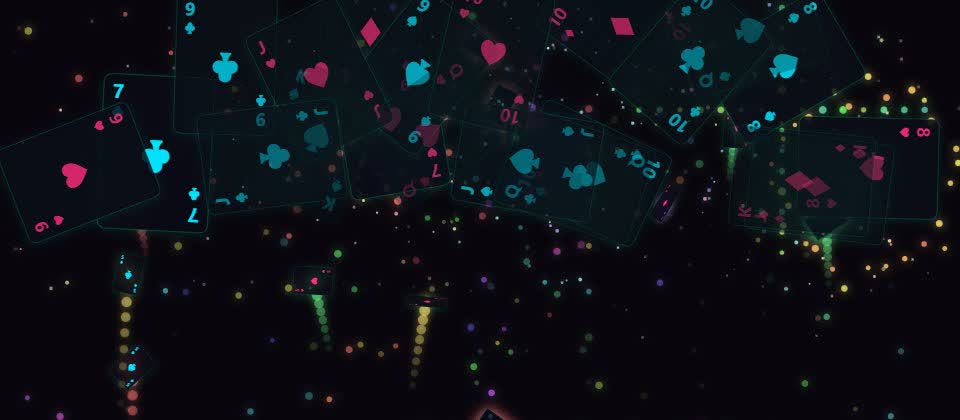
Fireworks alone has eight burst patterns across six palettes, with its own launch, boom and crackle.
Built out, not stubbed out.
Plays properly on a controller
Not a mouse pointer pushed around with a stick. A real cursor that moves pile to pile, up a fan to grab part of a stack, and a trigger you hold to peek under a card. Every screen navigates on the pad.
Draw one or draw three
Standard Klondike either way, with unlimited undo.
It tells you when a board is dead
Stuck detection counts only moves that make real progress, so it speaks up when it matters and stays quiet when it doesn't.
Five card styles
Including a card back that plays video.
Or a mouse, a finger, or a pen
All four run through one input path, so a touchscreen gets bigger targets instead of a shrunken desktop layout.
Records worth keeping
Personal bests, streaks and milestones per mode, with your last two hundred games kept.
Pause that actually pauses
Opening settings stops the clock and puts the scene to sleep.
Every deal is a code.
Boards aren't random at play time — each one comes from a number. Which means a board can be written down, sent, and dealt again exactly, on someone else's machine.
Win, and the code carries more than the board. It carries the game: every move in order, replayable at speeds from a quarter to eight times, steppable one move at a time. Send someone your win and they can watch you make it.
It's also the groundwork for something harder. A move log is something a server can re-run and verify independently, which is what a competitive board would need to be worth entering.
Deal challenge
TD-4K9WQ2-3
Same seven columns, same stock, same order. Play the board they played.
Full replay
TR-4K9WQ2-3-D|Mw0,t3|Ft2,5,1…
The board plus the whole game, move by move.
What's being built next.
Listed here because it isn't in the game yet.
Hear about it once, when it's out.
One email on release day. No newsletter, no drip, and you can leave with one click.